













































GLP-1 injections help suppress appetite and manage blood sugar, but weight loss can appear to slow over time

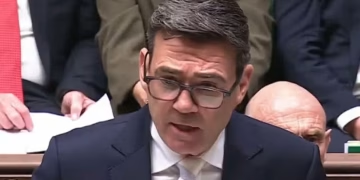
Dr Amir issued advice to anyone using weight loss jabs(Image: Dr Amir Khan/Instagram)
A doctor has shed light on why your weight loss may appear to have “plateaued” while using GLP-1 injections. According to the medical professional, this is the “most common” query he receives from patients.
GLP-1 (glucagon-like peptide-1) is a hormone produced naturally in the gut that controls blood sugar levels and appetite. The usage of GLP-1 inhibitors, or receptor agonists, has skyrocketed in recent years due to their demonstrated success in controlling blood sugar in diabetic individuals and aiding weight reduction.
Administered via injection, certain of these treatments can be prescribed on the NHS to qualifying patients, functioning by reducing hunger so individuals eat less. Nevertheless, a medical expert has disclosed that some people using these injections may notice their weight loss beginning to plateau.
In footage shared on his Instagram profile, Doctor Amir Khan provided further insight. Dr Amir, who is widely recognised for his appearances on ITV, stated: “One of the most common questions I get asked is this, ‘Dr Amir, I started Mounjaro or a GLP-1 injection and the weight fell off initially, but now I’ve hit a plateau, has it stopped working?
“Well, the answer is probably not. When you first start these weight loss medications, they work in a few really clever ways.
“They slow down how quickly food leaves your stomach, they reduce appetite, they can help you feel fuller for longer, and can dampen down some of those food cravings that can be really difficult to control. So initially, many people eat less without feeling like they’re dieting or restricting their food and the weight comes off.”
Nevertheless, your metabolism may subsequently begin to decline. He added: “But your body is incredibly smart, your body doesn’t particularly like losing weight.
“From an evolutionary perspective, weight loss can look or feel to the body a bit like starvation, so as you lose weight, your body starts fighting back. Your metabolism can slow down slightly, you burn fewer calories because you’re carrying less body mass.
“Hunger hormones start to creep up again and the body becomes more efficient with the calories it does receive so even though the medication is still working and it is, the gap between the calories you’re eating and the calories you’re burning, become smaller and smaller still, so it can feel like your weight is plateauing.” Consequently, some individuals may require an increased dosage.
Dr Amir explained: “The higher dose can provide a stronger appetite-suppressing effect and help overcome some of those biological resistance mechanisms. But even then, weight loss often slows or plateaus, and I have to say that’s completely normal.
“Think of it this way, you’ve moved from the rapid weight loss phase into the weight maintenance phase. In fact, for many people, staying the same weight after losing a significant amount is actually a really good success.
“The medication may still be preventing that weight regain even if your scales are not moving. ” Should this occur, he advised “don’t panic”.
“So if you’ve hit a plateau, don’t panic,” Dr Amir said. “It doesn’t necessarily mean the drug has stopped working.
“It often means your body has adapted to a new weight. And the battle has shifted from losing weight to keeping it off.”
If you’re worried about your weight, you ought to consult your GP.

