












































The weedkiller is currently approved in Great Britain but its continued use is under review by the HSE, with a government decision due this year

(Image: Trudie Davidson via Getty Images)
A DWP minister has provided an update on a weedkiller used in UK school playgrounds and public spaces that critics describe as ‘toxic’. Glyphosate is currently approved for use in Great Britain, though its continued application is under review, with a ruling expected later this year.
The debate surrounding its safety remains heated – with supporters maintaining it poses no risk to humans. However, the product also has a significant number of critics who say it is unsafe.
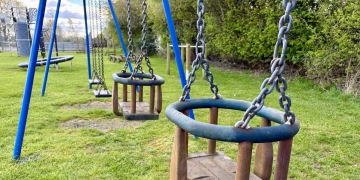
In January, the Pesticide Action Network (PAN UK) swabbed children’s play equipment across 13 playgrounds in Kent, Cambridgeshire, Milton Keynes, Tower Hamlets and Hackney, while also testing soil and plant material. PAN UK said that it discovered residues of glyphosate and its toxic breakdown product AMPA in 8 of the playgrounds.
The organisation said that “the contamination detected is likely to originate from the widespread use of glyphosate by UK councils to remove unwanted plants in public spaces” — particularly, they noted, given that none of the playgrounds were situated near agricultural land. The World Health Organisation has also classified glyphosate as a probable human carcinogen since 2015.
Many councils use glyphosate-based herbicides in public green spaces, though companies backing its use insist it is safe when applied correctly. In June, the Soil Association cautioned that its application as a drying agent by farmers leaves residues in everyday foodstuffs such as breakfast cereals, bread and beer, reports the Mirror.
However, many within the farming community argue it remains very important. The National Farmers Union, for instance, informed the BBC this summer that it is vital “to make harvesting easier, to control weeds, and reduce disease, and help produce sustainable and affordable food for all”.
The government is set to reach a decision on whether to approve the renewal of glyphosate by the end of this year. The issue has now been brought before Parliament following questions put to the Department for Work and Pensions (DWP) about when the Health and Safety Executive intends to launch its consultation on glyphosate approval renewal – and whether that consultation will examine its use in domestic gardens, schools and playgrounds.
On Monday, October 5, Sir Stephen Timms – Minister of State (Ministry of Housing Communities and Local Government) (Equalities) – said in response: “The Health and Safety Executive (HSE) is currently undertaking a renewal assessment of the pesticide active substance glyphosate to determine whether it continues to meet the strict approval criteria for use in pesticide products in Great Britain.
“As part of this, HSE is planning to launch a 60-day public consultation on its draft scientific assessment of glyphosate in due course. The uses that HSE is considering as part of this renewal assessment include the use of products containing glyphosate by professionals only in home gardens, schools and playgrounds. Other uses not assessed under the renewal assessment would be determined under individual product renewal assessments at a future date.”
With less than three months left in the year, time is running out to conduct the consultation before the end of 2026. When asked a similar question in June, Sir Stephen gave the same response – and yet there is still no information on when the consultation will begin.
The Health and Safety Executive is currently undertaking a reassessment of glyphosate, with officials seeking to establish whether it continues to satisfy stringent approval criteria. Nick Mole, Policy Officer at PAN UK, said when the organisation’s study was published: “It is deeply concerning to find a Highly Hazardous Pesticide like glyphosate present in the very places where our children play. UK glyphosate use has skyrocketed in recent years, as has the evidence linking this chemical to serious health conditions. We all know that young children tend to put their fingers and other items in their mouths so finding glyphosate residues in playgrounds, including on play equipment such as swings and slides, is particularly worrying.”
What do supporters of glyphosate use say?
Companies that use glyphosate strongly contest the assertions made by critics. They maintain that the medical consensus supports their position.
They argue that the substance poses no cancer risk to humans when applied according to instructions. And they say that the substance serves several important purposes.
They maintain that glyphosate benefits the environment by facilitating reduced tillage systems. They argue this safeguards soil and microorganisms, while reducing greenhouse gas emissions and fuel consumption.
The Glyphosate Renewal Group (GRG), a consortium of companies seeking approval for its continued use, says on its website: “Glyphosate is one of the most widely used active ingredients in herbicides designed to prevent unwanted weed growth in cultivated crops. Leading health authorities in the United States, Europe, for example Germany, Australia, Korea, Canada, New Zealand, Japan, and elsewhere around the world continue to conclude that glyphosate-based products are safe when used in accordance with the label instructions.
“Glyphosate-based herbicides have been used safely and successfully for more than 40 years and are among the most thoroughly studied products of their kind.”
Its website says the vast bulk of evidence backs their claims on the safety of the product. It notes: “Among the four World Health Organization (WHO) agencies that have evaluated the safety of glyphosate, the International Agency for Research on Cancer (IARC) is the only entity to find an association between glyphosate and carcinogenicity. In 2015, IARC classified glyphosate as ‘probably carcinogenic to humans’ and included it in the same category as everyday products like red meat and hot beverages.
“However, the WHO’s International Programme on Chemical Safety and Joint FAO/WHO Meeting on Pesticide Residues (JMPR) found that glyphosate is not carcinogenic, and its Guidelines for Drinking Water Quality found that glyphosate does not present a hazard to human health.” It adds: “In the EU, on June 15 2022, the designated European Member States for the current glyphosate renewal process – known as the Assessment Group on Glyphosate (AGG), published the main conclusions of their draft Renewal Assessment Report (dRAR) for glyphosate. Based on its assessment, the AGG proposed that a classification of glyphosate with regard to carcinogenicity is not justified.
“More than five years after reaching its opinion, IARC remains an outlier, as leading pesticide regulators around the world continue to conclude that glyphosate is not carcinogenic and that glyphosate-based herbicides are safe when used in accordance with the label instructions.”

