
















































Publisher stablecoins USDC, Circle, faces legal action after failing to stop the flow of funds resulting from Drift Protocol exploitation. Its value is not small; previously reported at US$280 million.
Circle Judged Negligent in Freezing Drift Hacking Funds
Lawsuit against Circle submitted by Drift Protocol investor, Joshua McCollum, in the Massachusetts district court, United States, on Tuesday (14/04/2026). He represents more than 100 investors affected by the hacking incident on April 1.
The bottom line is clear: Circle is thought to have failed to act quickly enough to freeze the funds resulting from the hack. This delay is considered to increase the losses experienced by investors.
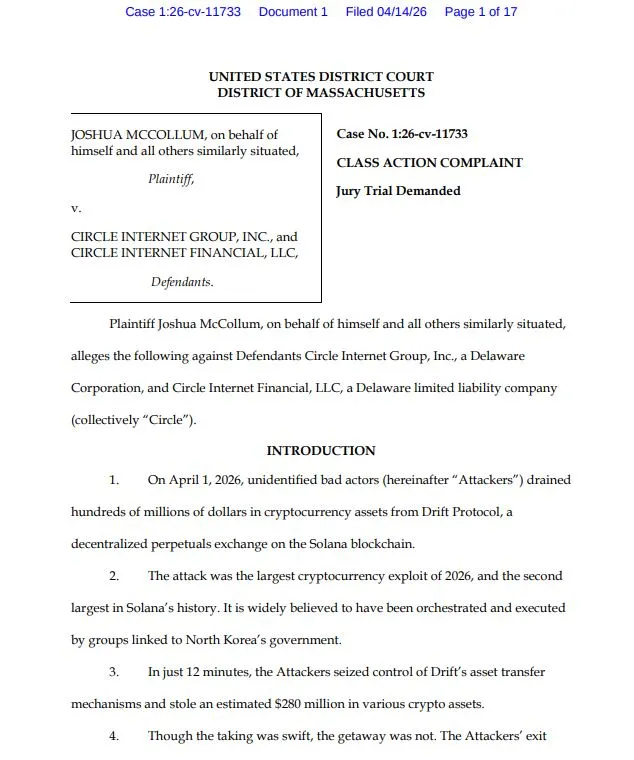
In the lawsuit, Circle is accused of allowing the perpetrator to move US$230 million in USDC from Solana to Ethereum. This process took several hours via Circle’s CCTP without any intervention.
ADVERTISEMENT

“Circle condoned criminal use of its technology and services. These harms would not have occurred, or at least could have been minimized, if Circle had taken timely action,” McCollum’s legal team wrote.
Not only that, Circle was also accused of neglect (aiding and abetting) as well as negligence. The Mira Gibb law firm representing the investors is now demanding compensation, with the final amount to be determined in the trial process.
Regulatory Gray Areas and Technical Capacity Circle
This case highlights a dilemma in the crypto industry: to what extent companies responsible on user funds. Circle does have the technical ability to freeze assets, but this decision is often hampered by regulations and the need for legal authorization.
McCollum’s legal team also highlighted that Circle had previously frozen wallets USDC in other cases before the Drift incident. This is considered to strengthen the argument that Circle actually has the capacity to take similar action.
“For example, on March 23, 2026, Circle froze USDC held in 16 wallets related to a closed civil lawsuit in federal court. This action made it impossible for those funds to be moved or used on the network blockchain,” they explained.
However, until now Circle has not responded to the lawsuit. This lack of clarity further emphasizes the “gray” position that many crypto companies find themselves in as incidents unfold real-time.
Meanwhile, the perpetrator behind this attack is suspected to be a state-backed hacking group North Korea. They are said to have carried out more than 100 transactions via technology bridging Circle property during business hours in the United States.
Funds Laundered Through Cash Tornado, Circle in Difficult Position
Once successfully transferred, the hacked funds are converted into Ethereum. Next, the assets are flowed through the protocol crypto mixer Tornado Cash to disguise traces of transactions.
This step makes the tracking process more difficult and also complicates efforts to recover funds. In this situation, pressure on Circle increased because it was considered the starting point that should be able to stop the flow of funds.
Revealed! The US$285 Million Hack at Drift Allegedly the Work of North Korean Hackers
However, not everyone blames Circle. Research director digital assets ARK Invest, Lorenzo Valente, evaluate Circle’s decision not to freeze funds is debatable.
“Future freezes are now subjective. Any decision not to freeze is also a political statement. Why freeze Drift hackers but not fraud wallets from Nigeria? Why is one frozen, but not the other?” he said at X, Friday (17/04/2026).
This case is a big test for the crypto industry. It’s not just a matter of security, but also concerns the limits of responsibility, regulation and trust in an ever-evolving ecosystem.
That’s the summary crypto news today which you can watch to follow developments in the world of digital assets and blockchain technology. Stay tuned Blockchain Media Indonesia For updates Latest about the crypto market, news bitcoinsto study guides crypto for those of you who are still beginners. [dp]
Disclaimer: Content in Blockchainmedia.id is informational only, not investment or legal advice. All financial decisions are the sole responsibility of the reader.

