

































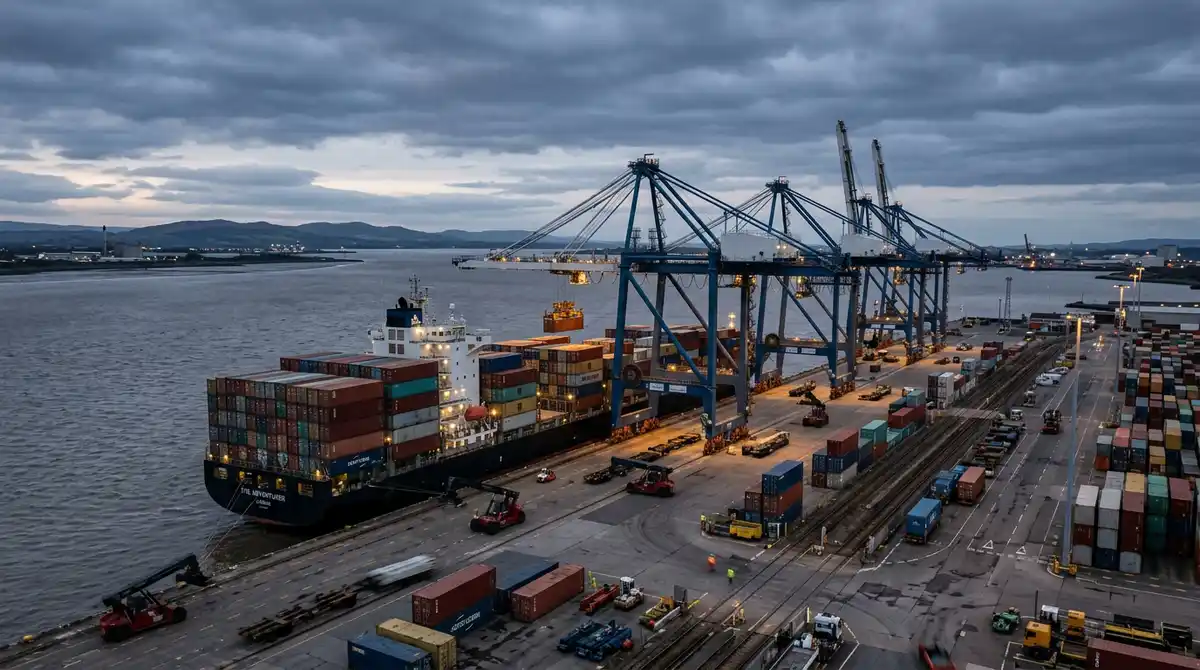
The chief executive of The Bristol Port Company, David Brown, has been chosen to lead the body that speaks for Britain’s biggest port operators, giving Avonmouth and Portbury a prominent voice in national debates on trade, energy and infrastructure.
Mr Brown has been appointed chair of the UK Major Ports Group (UKMPG), succeeding Henrik Pedersen, chief executive of Associated British Ports (ABP), who has held the role for the past three years. Stuart Wallace, chief executive of Forth Ports, becomes vice chair. The appointments were announced at the group’s annual reception at the House of Commons earlier this month, according to a statement published by The Bristol Port Company.
A Bristol voice at the top table
The UK Major Ports Group represents nine of the country’s largest port operators, which together run 40 ports and handle around 75% of UK port volumes, as Interchange UK reported. Its members include ABP, The Bristol Port Company, Forth Ports, DP World, Hutchison Ports, PD Ports, Peel Ports Group and the Port of London Authority.
The chair works alongside the group’s chief executive, Geraint Evans, to represent the industry to ministers and officials. Mr Brown will hold the post alongside his day job running the Bristol port business, at a time when the government is looking to infrastructure to lift economic growth.
Commenting on his appointment, Mr Brown said: “Ports are central to the UK’s future prosperity. They keep trade moving, support jobs and investment in communities across the country, and are playing an increasingly important role in strengthening national resilience and enabling the energy transition.”
He has also said he intends to work with fellow port chief executives and with government to make sure the sector continues to contribute to sustainable economic growth. Mr Wallace said he looked forward to championing the role ports play in driving growth across the country and strengthening Britain’s trade connections.
What the sector wants from government
The change of leadership comes as ports take on a wider set of responsibilities. Industry coverage of the appointments points to an expanding role in international trade, energy security, offshore renewables and national infrastructure resilience, alongside the cost of decarbonising port operations themselves.
Outgoing chair Mr Pedersen said the sector had broadened its contribution during his three-year tenure, with greater recognition of the role ports play in energy security, partnerships with the armed forces and decarbonisation. Mr Evans paid tribute to his leadership and counsel, which the group says helped raise the sector’s profile and strengthen its voice with government.
Mr Evans described both Mr Brown and Mr Wallace as experienced leaders who understand the opportunities and challenges facing the industry, and said their leadership would help the group maintain its engagement with government. The House of Commons reception was attended by Keir Mather, the minister for aviation, maritime and logistics, according to a photo caption published with the announcement and a Logistics UK public affairs round-up.
Planning, grid connections and road and rail links are recurring themes for port operators seeking to expand, and the new chair will be expected to press the industry’s case on each of them with Whitehall.
What it means for Bristol readers
For the Bristol area, the appointment places the head of one of the region’s most important pieces of infrastructure at the centre of national port policy. The Bristol Port Company describes itself as Bristol’s global gateway. Based at Avonmouth on the Severn estuary, it says it is the UK’s only deep-water port with direct motorway and rail connections in every direction, and that it can handle vessels of up to 130,000 deadweight tonnes, alongside warehousing, logistics and cruise business.
The port has positioned itself as a hub for the energy transition, and its role has grown as major projects in the South West have relied on it. Mr Brown’s new position means the concerns of a West Country port, from road and rail connectivity around Avonmouth to the regulatory environment for offshore wind supply chains, are likely to be heard more directly in Westminster.
The appointment also comes during a busy week locally for the port. The company reported that a new Avonmouth Seafarers’ Centre opened on Tuesday 17 November, with Mr Brown among those addressing members of the port community at the launch.
For local businesses that depend on imports and exports through the Severn ports, a stronger national profile for Bristol could translate into greater attention for investment cases and infrastructure bids that affect the wider West of England economy.
What happens next
Mr Brown and Mr Wallace take up their roles immediately, combining them with their executive positions at their own companies. The pair are expected to lead the group’s engagement with government on trade, energy security and planning reform over the coming years, while Mr Pedersen remains a member through ABP.
Key tests for the new leadership will include how quickly port expansion schemes can secure consents, how the industry funds its own decarbonisation, and how ports are integrated into the UK’s wider defence and resilience planning, an area Mr Pedersen highlighted during his tenure.
The Bristol Port Company said it congratulated both men on their appointments and wished them every success in championing the UK ports sector. A report in the Freight Business Journal confirmed the line-up, noting that Mr Pedersen had chaired the group alongside Mr Evans for the past three years.
For Bristol, the immediate effect is one of profile rather than policy. Over time, though, having the head of the city’s port lead the industry’s national lobbying effort is likely to keep the Severn estuary firmly on the map as ministers decide where the next wave of infrastructure investment should go.

